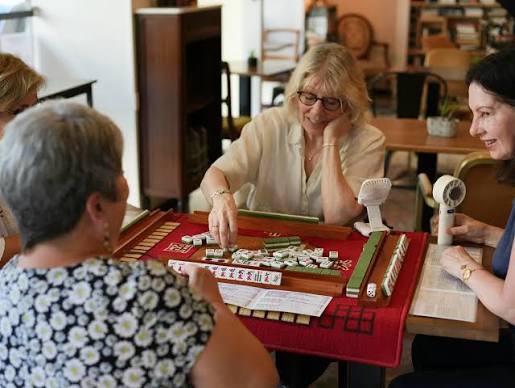
At a mahjong table, four people sit around a wall of tiles and take turns picking one up and putting one down. That is most of what happens for the first twenty minutes. Then, somebody pushes their tiles forward and says they’ve won, and the other three find out they were one tile short. The game is more than a century old in its modern form, and it is still played in homes, in community centers, and now on phones.
Where mahjong came from
Most available records show the start of mahjong in China in the 1800s. That’s around the Shanghai area, though nobody has pinned it down. It came out of older card and tile games. Money was usually on the table, which is how the link with gambling began.
Within a few decades, it had spread across China and from there to Japan, Hong Kong, and Southeast Asia, with each place adding its own rules. Today, the tiles turn up in the lobby of an internet casino, mostly on slot games with a mahjong theme.
Coming to America
Mahjong reached the US in the 1920s. The credit goes to an American named Joseph Babcock, who had lived in China. He wrote up a simplified set of rules for it, and the game caught on fast. Sets sold out in stores and players were soon arguing about whose rules were correct.
The arguments were settled in 1937, when a group of women in New York started the National Mah Jongg League. The League prints a card every year with the winning hands on it. That card is the main reason American mahjong looks so different from the version played in Asia.
The tiles
A standard set has 144 tiles. Some versions play with 136, and American sets have 152 because of the jokers. The tiles fall into a few groups:
- Three suits, usually called dots, bamboo, and characters, numbered one to nine
- Honor tiles, which are the four winds and three dragons
- Flowers and seasons, which are bonus tiles
- Jokers, used only in the American version
How a turn works
Four players sit around a table, and each is dealt 13 tiles. On a turn, a player draws a tile and then discards one, face up, in the middle. The next player decides whether to take the discard or draw from the wall.
A player can also claim a discard to complete a set. A pung is three identical tiles, a kong is four, and a chow is three tiles in a row from the same suit. The Asian versions allow chows. The American game generally does not.
Winning a hand
A winning hand has 14 tiles. In most versions, those are made up of four sets and a pair. The player who completes one says mahjong. Then he lays the tiles down for the table to check. The counting of the points depends on the version being played. Some give points for every set, and others use fixed values for certain hands. In American mahjong, the hand has to match one on the card.
American play also has the Charleston, a swap at the start where players pass unwanted tiles to the left, across, and to the right.
Mahjong online
Playing online has made the game easier to try for people who don’t have three friends free to join them. Apps pair players with others around the world and it’s this convenience that it has become one of the many ways to entertain online for puzzle lovers. One warning is worth giving. The solitaire game called mahjong, which has players matching pairs of tiles on a screen, is a different game, though it uses the same pieces.
Learning to play
The best way to learn is by playing with people who already know how. Beginner groups are common at community centers, libraries, and senior centers. The National Mah Jongg League also puts out a new card and rulebook every year. Some experienced players find work online, giving lessons over video, though for most people mahjong stays a hobby.
The first game tends to drag, and half the table will be confused. By the third or fourth, most people are calling out their own discards and wanting another round.