Skin diseases, as I always say, are more than skin deep. They are diseases that appear on the skin, but in reality, they originate at the level of immunity and show up on the skin.
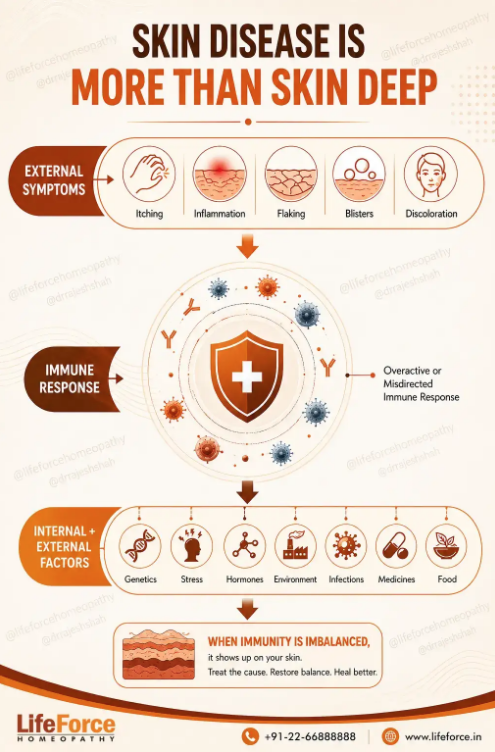
In simple words, most skin diseases are nothing but a reflection of an altered or diseased immune system. On a lighter note, when the immune system starts misbehaving, one develops a skin disease. No chronic skin disease may occur just like that. There has to be a prominent reason for the body to develop a skin disease. One has to understand it in more detail to be able to approach skin disease treatment wisely.
Which skin diseases?
This is true for many common skin diseases, including but not limited to psoriasis, vitiligo, eczema, lichen planus, and urticaria (hives). Some more severe skin diseases are cutaneous Systemic Lupus, discoid lupus, blister diseases like pemphigus, vasculitis, etc.
All of these conditions can be easily assessed through our Skin disease assessment test tool at Life Force Homeopathy. Our short test is capable of giving you a clear picture of your recovery potential and whether you need further medical assistance or not.
What causes skin diseases?
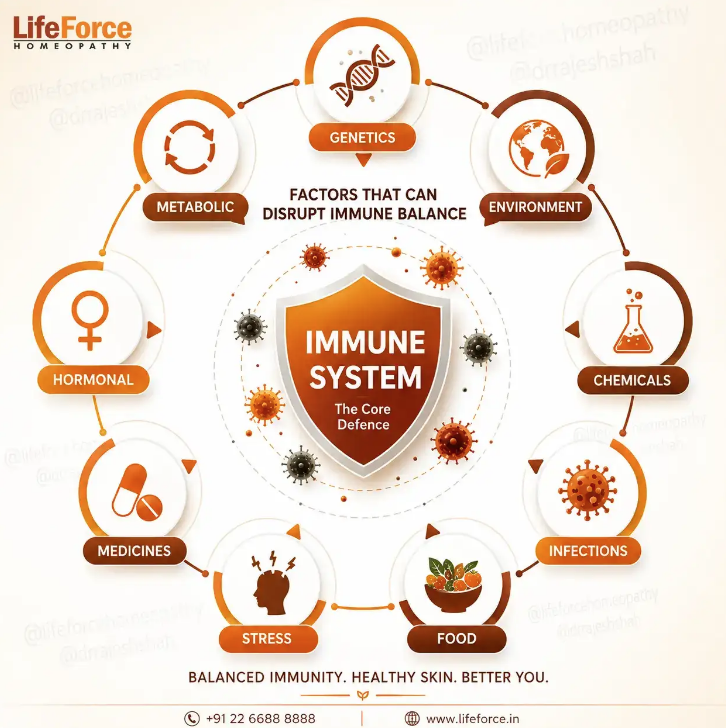
Most chronic and recurring skin diseases are due to a weakened or compromised immune system. And how does the immune system get affected? What is the cause of the misbehavior of the immune system? Well, the immune system is governed and affected by many factors, such as internal and external factors. Internal factors include genetics, stress, metabolism, and hormones. External factors include Infections. Medicines, Chemicals, Food, environment, etc.
- Genetic
- Environment
- Chemicals
- Infections
- Food
- Stress
- Medicines
- Hormonal
- Metabolic
- Others
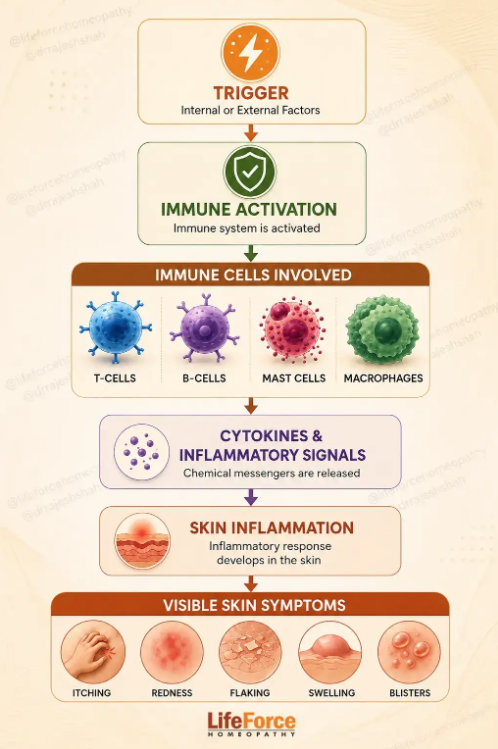
How can an immune response affect the skin? A simplified view of immune activation, inflammatory signals, and resulting skin symptoms.
What do you mean by ‘misbehaving immune system’?
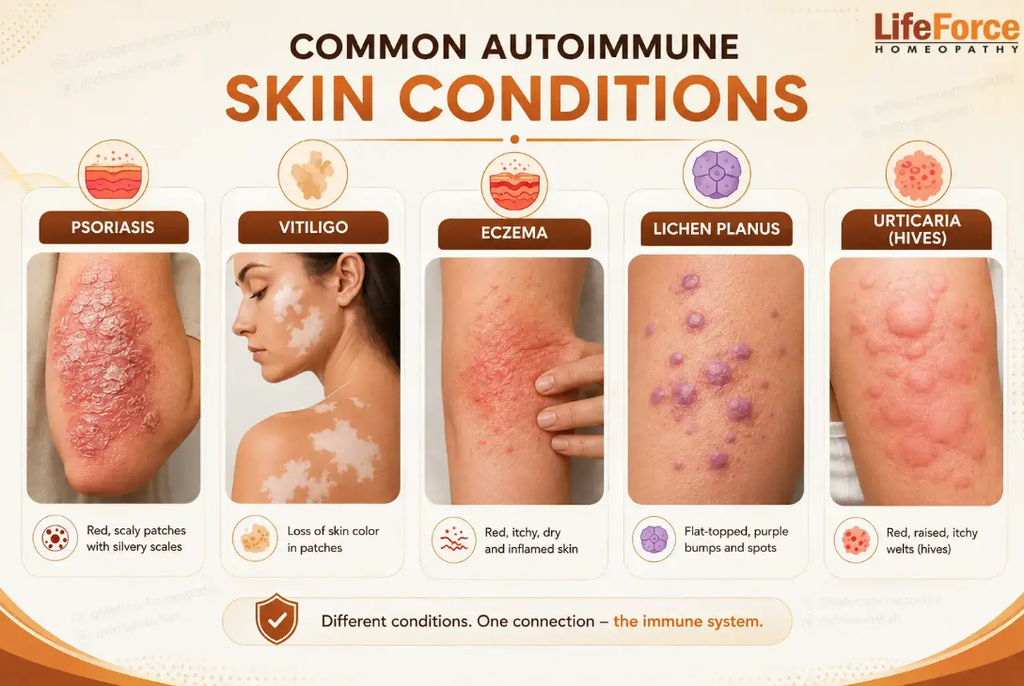
In simple terms, the immune system is made up of innate and adaptive branches. This leads to persistent, misdirected inflammation on the skin in the form of an immune response. Such an immune response is overactive or mistargeted, attacking healthy skin tissues or reacting harmlessly to triggers. As a result, there is not only severe and prolonged inflammation, but there may be one or more of the following skin lesions:
- Inflammation
- Flaking
- Itching
- Discharge
- Boils
- Blisters
- Ulcers
- Wound
- Hardening
- Swelling
- Overgrowth
So, skin diseases are nothing but a combination of one or more of the above features. Itching is the most common form of immune response.
A little more detail…
There are two key immune components involved in most skin diseases. T-cells and B-Cells. T-cell-related immunity is called Adaptive immunity, which releases certain signaling proteins (cytokines), leading to chronic inflammation in eczema and psoriasis. T-cells comprise mainly Th1, Th2, and Th17 cells, which interact with many other proteins and finally lead to the symptoms of skin diseases such as inflammation and flaking.
B-cell activation leads to the production of ‘self-attacking’ proteins such as antibodies, which are destructive and lead to blisters in pemphigus, which is more complex.
Another type is innate immunity, governed by mast cells and macrophages, which release chemicals that cause inflammation, redness, swelling, and itching.
How not to treat skin diseases?
Well, everyone likes to focus on how to treat skin diseases. However, I am talking about how not to treat skin diseases, because it is often seen that if skin diseases are treated superficially using topical immunosuppressants, the diseases relapse when the use of such medicines is stopped, like corticosteroids and other similar products. Of course, conventionally, the immunosuppressants mentioned here have been found to be useful. However, when you stop using them, the chances of relapse and flare-ups are very high.
What could be triggering your skin condition?
What happens on the surface is merely a part of your problem. Chronic or recurring skin conditions can be influenced by several factors like stress, lifestyle, immunity, triggers, disease duration, and overall health, which may affect your recovery.
All of these conditions can be assessed through our Skin disease assessment test. Our short test is capable of giving you a clear picture of your recovery percentage and whether you need further medical assistance.
How long will you keep ignoring recurring skin symptoms?
Recurring skin problems are more than just temporary flare-ups; analyzing them is the first step to recovery.
How does homeopathy treat skin diseases?
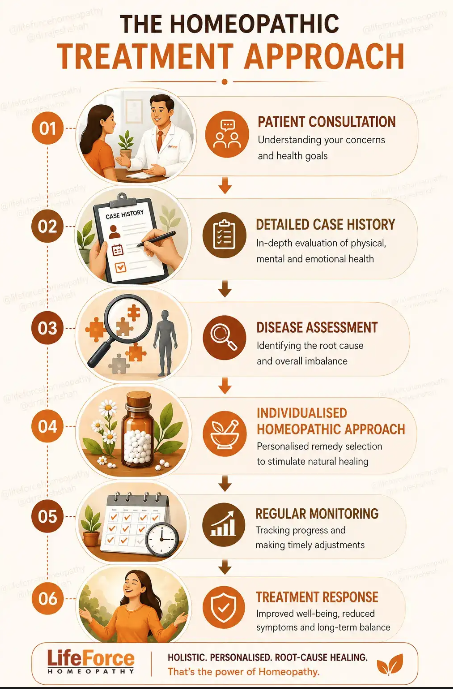
Homeopathy is another approach to treating skin diseases. Let me admit that treating skin diseases using homeopathy is possible but not very easy! The homeopathic approach attempts to address the underlying immune system without using immunosuppressants. Certain homeopathic medicines seem to correct altered immune systems and address B-cell and T-cell responses. The selection of homeopathic medicines may vary depending on the patient’s symptoms, conditions, past medical history, disease duration, and overall health.
Therefore, consulting a qualified homeopathic doctor is important. The exact mechanism of action of homeopathic medicines is not yet understood, but it can be clinically observed that many skin diseases respond well to homeopathic treatment. Of course, not all chronic skin conditions are easily treated by homeopathy. But overall, the results are encouraging and positive.
Which skin diseases respond well to homeopathy?
Many chronic skin diseases respond well to homeopathy, especially if they are treated at an early stage, if they are not extremely widespread, and if they are not treated with aggressive immunosuppressants. In general, cases of urticaria (hives), vitiligo, lichen planus, psoriasis, eczema, prurigo vulgaris, warts, and fungal infections respond well to homeopathic treatment. The scope of vitiligo treatment, psoriasis treatment, and lichen planus treatment in homeopathy may depend on the extent, severity, duration, and stage of the condition, etc.
Our research has shown that homeopathic medicines may activate the process of melanogenesis in vitiligo (Link to paper). We have seen that homeopathic medicines may alleviate chronic inflammation even in an animal model (link to paper), thereby alleviating inflammation in diseases like psoriasis, urticaria, and eczema.
When does it become difficult to treat using homeopathy?
Clinical experience suggests that if the disease is extremely severe, for example, widespread infantile eczema all over the body, it is difficult to treat in homeopathy. If vitiligo is spread over 40% of the body, it is not possible to cure it using homeopathy. Similarly, if psoriasis has affected joints, leading to psoriatic arthritis, it is very difficult to give relief in such cases. Likewise, if the patient has consumed a lot of immunosuppressants such as corticosteroids, methotrexate, or cyclosporine, it is very difficult to treat such cases using homeopathy.