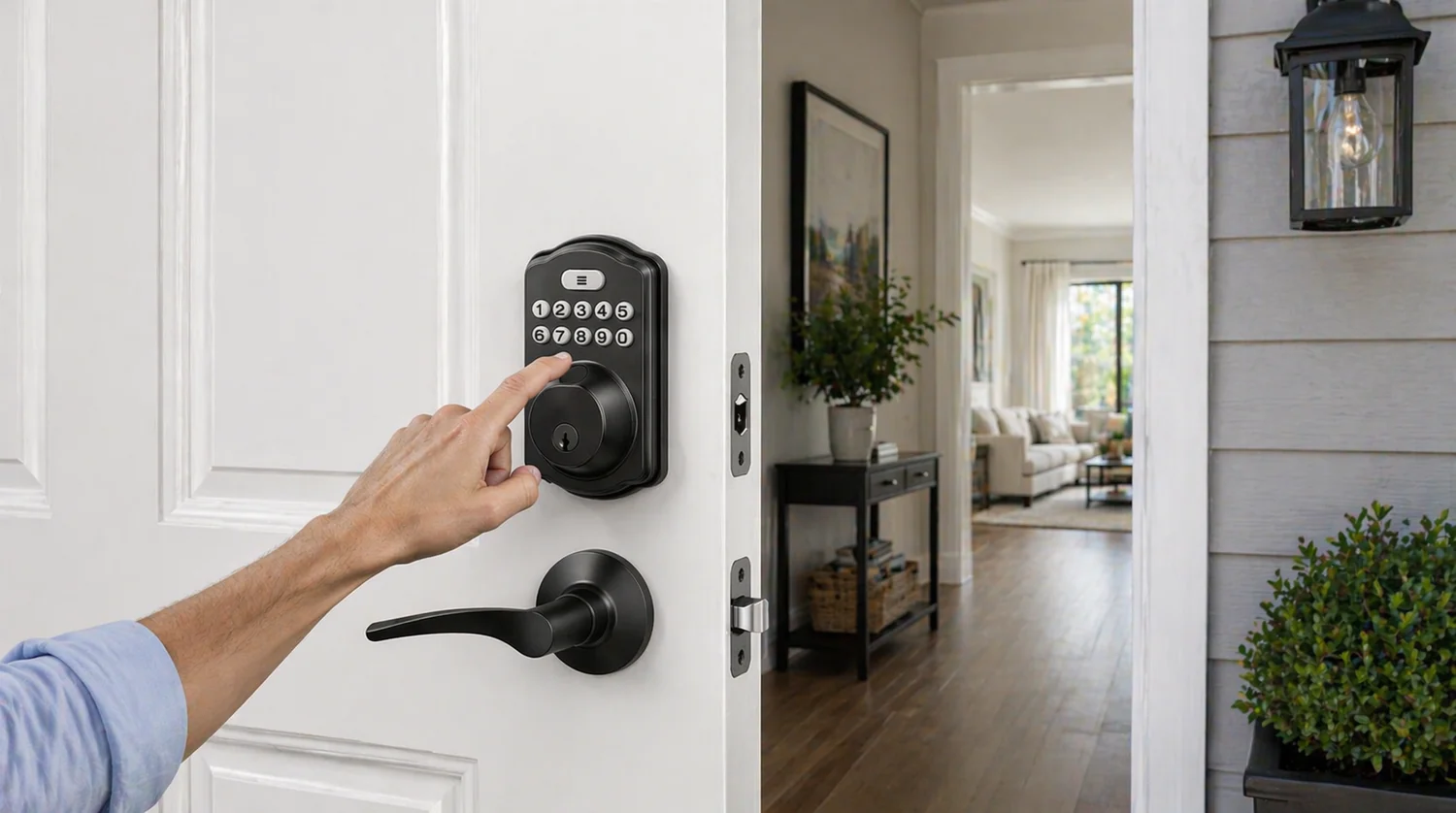
Paradoxically, the greatest threats to our locks are rarely the sophisticated tools of a professional intruder, but rather simple, everyday objects we use without a second thought.
That’s because a lot of them can degrade a lock’s internal mechanisms over time, leading to jammed cylinders, snapped keys, and expensive emergency call-outs.
Luckily, all this is easily avoidable if you take some time to learn more about it, which is why we’ve compiled a list of the 8 most common everyday items that can silently sabotage your locks.
Read on!
Overloaded Keychains That Stress The Cylinder
A heavy bundle of keys is a pretty common sight in the UK. Some may even feature everything from the front door and the garden shed to gym fobs and souvenir keyrings.
While it might be convenient to have your entire life attached to one ring, the sheer weight of a heavy keychain is a leading cause of premature lock wear.
When you insert a key into a lock, the weight of the dangling bundle creates a constant downward pull. This torque puts unnecessary pressure on the delicate internal pins and the plug of the cylinder.
Over months and years, this can lead to the misalignment of the pins, making the lock feel “notchy” or difficult to turn.
In some extreme cases, the internal components can warp or wear down to the point where the correct key no longer aligns the shear line. This effectively locks you out of your own home via nothing more than the force of gravity.
Standard WD-40 And Other Non-Specialist Lubricants
This is perhaps the most common mistake made by well-meaning British homeowners.
When a lock starts to feel a bit stiff, the instinctive reaction is to reach for a can of standard WD-40 and while it might provide a temporary “quick fix”, it is not a long-term lubricant for precision locks.
That’s because standard WD-40 contains light oils that eventually evaporate, leaving behind a sticky residue. And, in the damp British climate, this residue acts as a magnet for dust, pocket lint, and microscopic debris.
What this does over time is it creates a thick “gunk” inside the cylinder that can seize the tiny springs and pins.
For a lock to function correctly, it’s best to go for dry lubricants like graphite powder or specialist PTFE-based sprays that do not attract dirt. Otherwise, the lock can start malfunctioning and fail within months.
Poorly Cut Duplicate Keys From Unverified Sources
We have all been there: you need a spare set of keys for a neighbour or a relative, so you pop into a local high-street cobbler or a “while-you-wait” key-cutting booth.
While these services are incredibly convenient, the quality of the resulting key can vary wildly. A key that is even a fraction of a millimetre off the original specifications will still “work,” but it will force the internal pins to sit at slightly incorrect heights.
This means that every time you force a poorly cut key into the cylinder, you are essentially “sanding” the internal components of the lock.
You might notice you have to jiggle the key or pull it out slightly to get it to turn. That is a clear sign that the key is compromising the lock.
Eventually, the lock will adapt to the “bad” key, meaning the original, high-quality key may stop working altogether, and the security of the cylinder will be significantly diminished.
Harsh Chemical Cleaning Products And Abrasive Pads
We all want a clean and presentable front door. However, many of us inadvertently damage our locks with aggressive cleaning routines.
That’s because standard household cleaners, particularly those containing bleach, ammonia, or acidic components, can be devastating to the finish and the internal health of a lock.
These chemicals can cause the protective plating on the lock—whether it is brass, chrome, or nickel—to peel or corrode. Once the plating is compromised, moisture from the British weather can seep into the base metal, leading to oxidation and rust.
Similarly, using abrasive scouring pads or steel wool to remove tarnish can create microscopic scratches that hold moisture and accelerate the breakdown of the metal.
A gentle wipe with a slightly damp microfibre cloth and some mild soap is usually all that is needed to keep the exterior of a lock looking good without risking its structural integrity.
Cooking Oils And Household Greases
When a lock is stuck, and there is no lubricant in the shed, some people turn to the kitchen cupboard for a solution.
Using vegetable oil, olive oil, or even butter to “grease” a lock is a recipe for disaster. Unlike specialist lubricants, organic oils are prone to oxidation and will eventually go rancid and thicken into a stubborn, glue-like substance.
This “gumming up” process happens relatively quickly and can completely immobilise the internal springs that allow the pins to move.
Once cooking oil has dried inside a lock, it is incredibly difficult to remove without completely dismantling the cylinder.
So, if you find yourself tempted to use a kitchen staple to fix a stiff door, it is far better to wait and purchase a proper dry lubricant or schedule a visit with an expert lock installation and repair specialist who can clean the mechanism properly.
Thick Layers Of Decorative Exterior Paint
The “landlord special”—the habit of slapping a fresh coat of paint over everything on a door—is a major contributor to lock failure.
When painting a front door, it is essential to mask off the lock faceplate, the latch, and the deadbolt. That’s because if paint is allowed to seep into the keyhole or coat the moving parts of the latch, it creates friction and physical obstructions.
Thick layers of paint can also prevent the latch from retracting fully or stop the deadbolt from extending into the strike plate on the door frame.
Furthermore, if the strike plate itself is painted over, the tolerances of the lock change, often requiring the user to “heave” or “pull” the door just to get it to lock. This constant physical strain eventually leads to the mechanical failure of the handle or the internal gearbox.
Foreign Objects Used As Make-Shift Tools
It sounds obvious, but the number of locks compromised by “emergency” DIY attempts is staggering.
Whether it is a child poking a lolly stick into the keyhole or an adult trying to clear a blockage with a paperclip or a safety pin, inserting foreign objects into a lock is always a high-risk move.
Modern lock cylinders are incredibly precise, so even a tiny fragment of wood or a snapped piece of wire lodged at the back of the plug can make it impossible to insert a key.
And, if a key snaps off in the lock, the temptation is often to try to remove it with a screwdriver. This almost always results in pushing the broken fragment deeper or scratching the internal wafers.
So, in these situations, the “everyday item” becomes the exact thing that turns a simple extraction task into a full lock replacement.
Sticky Tape And Adhesive Residue
During the holidays or for local celebrations, it is common to tape decorations, “No Solicitor” signs, or delivery notes directly onto the front door.
However, if tape is placed over or near the lock, the adhesive residue can act as a silent killer. That’s because, as the sun hits the door (on the rare occasions it appears in the UK), the adhesive softens and can migrate into the keyhole.
Once inside, it combines with dust to create a sticky trap for the internal pins. Even a tiny amount of residue on your key can be transferred deep into the cylinder, where it will eventually cause the pins to stick in the “up” position.
This not only makes the lock difficult to use but can also leave the lock in a “picked” state, where it can be turned with a simple flathead screwdriver, completely compromising your home security.
Conclusion
As you can see, using these 8 everyday items will damage your locks, sometimes not immediately, but definitely.
However, now that you know these common mistakes, you can easily avoid costly repairs or even lock replacements. Remember, if you’re unsure about something, just check. Better to be safe than sorry.
That way, your home will stay protected, and you’ll have peace of mind that your locks will serve you faithfully for a long, long time.
Good luck and stay safe!