Around the world, astronomers are updating their charts of the solar system after Saturn’s family of moons swelled to a record 274. The confirmation of 128 new satellites, announced following formal recognition by the International Astronomical Union, gives Saturn a lead over Jupiter — now on 95 moons — that no other planet comes close to matching.
The new arrivals are irregular moons, small bodies only a few kilometres across that circle Saturn far out, on orbits tilted sharply against the planet’s equator. Many are believed to be fragments of larger objects captured and shattered long ago.
An international hunt for faint companions
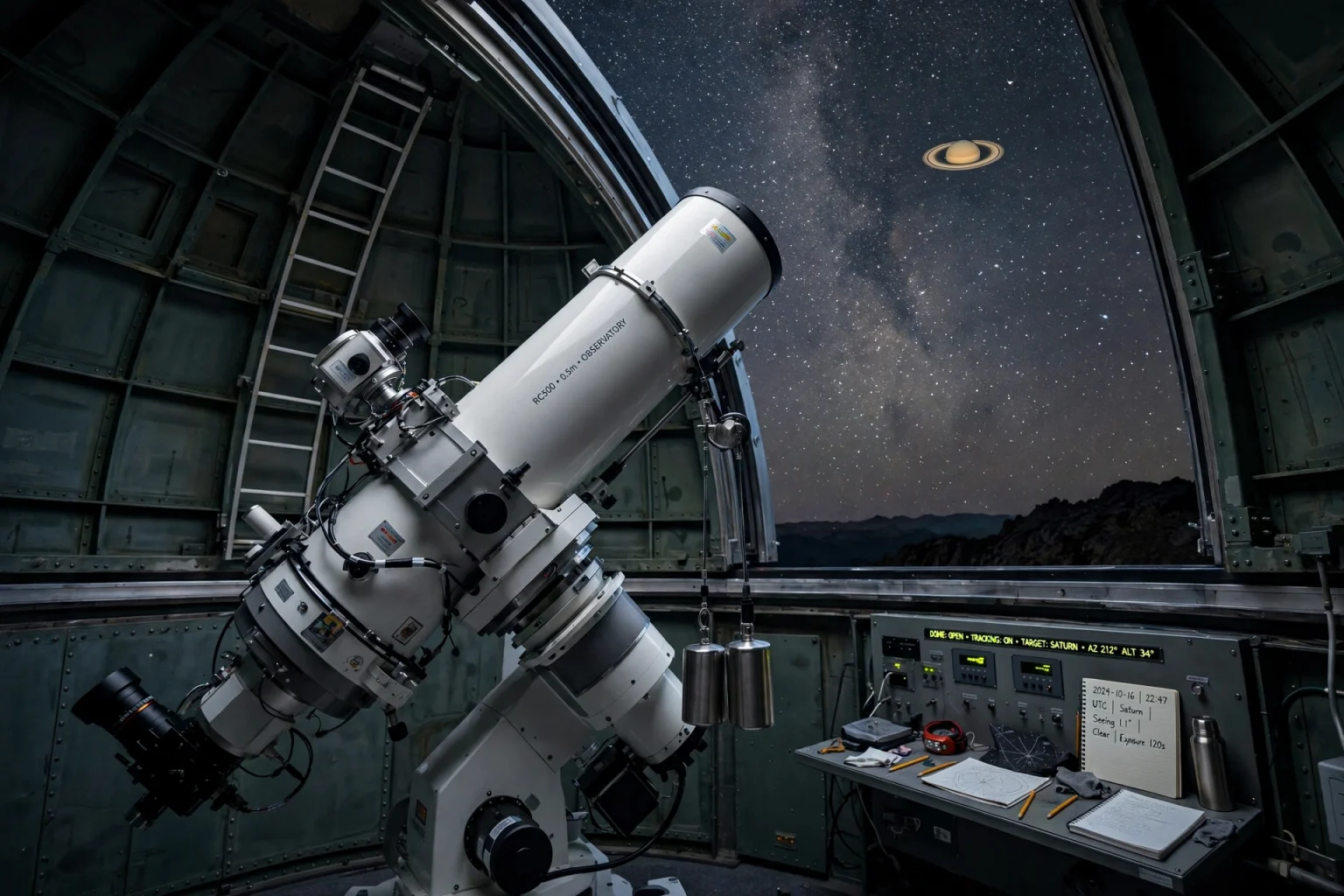
The moons were found in data from the Canada-France-Hawaii Telescope in Hawaii, where astronomers stacked repeated long exposures to reveal objects that move with Saturn but are invisible in any single image. Researchers at the University of British Columbia in Canada led the years-long work of tracking the candidates until their orbits were secure.
The effort spans continents and observing seasons — a reminder that the biggest catalogues in science are assembled collaboratively and slowly, in contrast to one-night spectacles such as the SpaceX launch that produced a jellyfish cloud over the East Coast.
What the fragments reveal
Irregular moons travel in families, groups whose shared orbits betray a common origin in a collision. With 128 additions, several families have grown substantially, giving scientists the numbers they need to date those collisions and reconstruct the environment in which Saturn’s system evolved.
Some researchers argue that one prominent family is surprisingly young, the product of a break-up within roughly the last few hundred million years. The enlarged census will test that claim, because a younger family should look tighter and less dispersed than an older one.
More worlds to find
Experts stress that 274 is not a final answer. Detection limits still hide what are likely thousands of small moons around the giant planets, and deeper surveys planned for the coming decade are expected to raise the totals again.
For now, the record belongs emphatically to Saturn: 274 confirmed moons, each one a small archive of the solar system’s restless early history, recovered one faint point of light at a time.
How the discovery was made, step by step
For readers picturing a single dramatic night at the telescope, the reality is more methodical — and more impressive. The survey team first imaged the region around Saturn repeatedly, building sequences in which the planet’s slow motion could be tracked precisely. Software then shifted those frames to follow Saturn and combined them, so that light from its faintest companions accumulated into visibility while the stars dissolved into streaks.
Each candidate that emerged was logged, re-imaged and checked against catalogues of known asteroids that might be passing through the frame. Survivors were followed across multiple years, their positions measured to extraordinary precision, until orbital calculations could predict their locations far into the future. Only at that point did the formal recognition process begin.
It is a workflow now being applied across the outer solar system, and its results are cumulative: every completed survey makes the next one faster, because astronomers know better where to look and what sensitivity is required. Saturn’s record of 274, remarkable as it is, should therefore be read as a progress report from an ongoing global effort — one in which the count, on all the evidence, has further to climb.
Educators, meanwhile, have a small task of their own: updating the charts. Classroom posters and textbooks around the world that list Saturn’s moons — many of them printed when the count stood below 150 — are now out of date for the second time in a few years. Publishers have learned to treat the figure as a moving target, and some school resources have taken to printing the date beside the number. It is a small, telling sign of a science still in motion, in which even the contents of our own solar system are not finished being discovered.