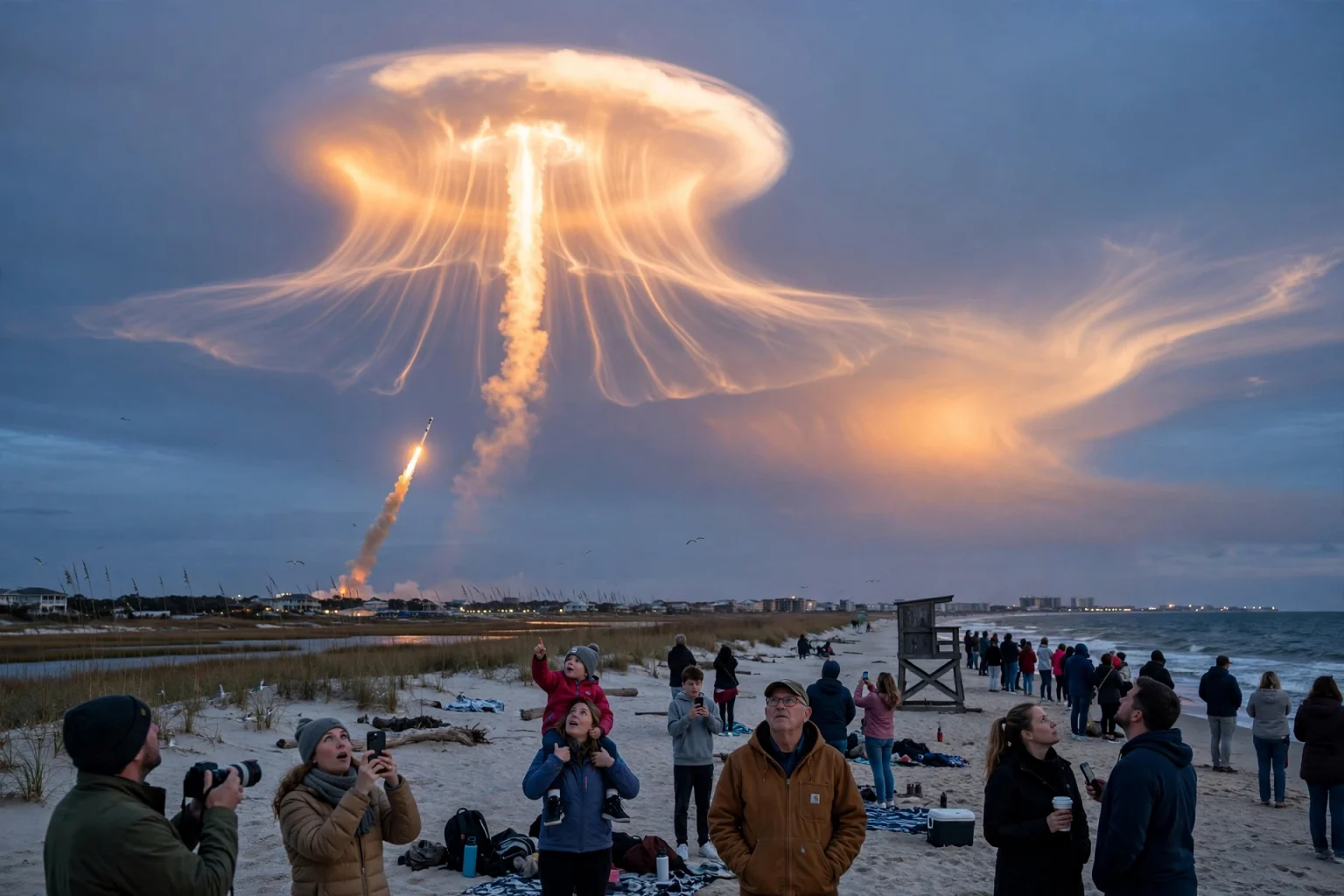
For a few unforgettable minutes, the sky over the US East Coast stopped looking like sky at all. A SpaceX rocket climbing through the upper atmosphere in fading twilight left behind a vast, glowing plume that billowed outward into the unmistakable shape of a jellyfish, its translucent bell lit from below the horizon while tendrils of exhaust curled beneath it. Beachgoers, commuters and amateur photographers from Florida to the Carolinas and beyond stopped, pointed and reached for their phones, and within the hour the images had spread across social media around the world.
What exactly is a jellyfish cloud?
The phenomenon has a straightforward physical explanation, even if the result looks anything but ordinary. When a rocket launches shortly before sunrise or shortly after sunset, the ground below is already in darkness, but the exhaust plume, tens of kilometres overhead, is still bathed in direct sunlight. That contrast is the whole trick. The sunlit exhaust expands in the near-vacuum of the upper atmosphere, spreading into a wide, diffuse fan rather than the tight trail seen during a daytime launch. Lit from behind and below, the expanding gas and ice crystals glow against the dark sky, creating the bell-and-tentacles silhouette that gives the effect its nickname.
Reporting on this week’s display, including coverage by The Guardian, noted just how far the spectacle travelled: observers hundreds of kilometres from the launch site reported clear views, because at that altitude the plume is visible across an enormous footprint. It is the same geometry that makes high clouds catch pink light long after sunset at ground level, scaled up dramatically.
Why twilight launches look so different
Timing is everything. A launch in the middle of the day produces a white contrail against a bright sky, impressive but familiar. A launch in full darkness produces a brilliant point of light and little else, because the plume has no sun left to catch. The magic window is narrow: roughly the half hour to hour either side of sunrise and sunset, when the observer is in shadow but the upper atmosphere is not. Mission planners do not schedule launches for the view, of course; orbital mechanics and destination dictate the clock. But when the two coincide, as they did this week, the result is a piece of accidental public art on a continental scale.
Weather plays a supporting role too. Clear skies along the coast allowed unobstructed views, and calm upper winds kept the plume coherent long enough for its shape to develop rather than being torn apart. Photographers who have chased previous twilight launches say the display typically evolves over ten to twenty minutes, the bell expanding and dimming as the exhaust disperses, before fading entirely as the sun’s angle drops or the plume drifts into Earth’s shadow.
A reminder of how busy the sky has become
There is a serious story underneath the pretty pictures. Launches from Florida’s Space Coast have become so frequent that residents who once treated every liftoff as an event now hear the rumble as background noise. Commercial constellations, national missions and cargo flights have turned what was a rare spectacle into a near-weekly occurrence, and spectacles like this week’s are a side effect of that new cadence: more launches simply means more chances for one to fall inside the twilight window.
That growing traffic is reshaping life on the ground as well as above it. Our recent coverage of how cities are rewriting their heatwave playbooks looked at one kind of adaptation; coastal communities near spaceports are quietly making another, adjusting to road closures, viewing crowds and the low thunder of returning boosters as ordinary features of the calendar.
How to catch the next one
If you missed this display, the good news is that the recipe is repeatable. Watch launch schedules for liftoffs timed within about an hour of sunrise or sunset at your location, then find a spot with a clear view toward the launch site and as little light pollution as possible. Binoculars help pick out the separation events and the faint second plume of a returning booster, but the jellyfish itself is a naked-eye phenomenon; indeed, a wide view takes in more of it than any lens. Photographers recommend a phone on night mode or a camera on a tripod with exposures of a few seconds, and patience: the best shapes often appear several minutes after liftoff, when the rocket itself is long gone from view.
Above all, look up promptly and stay looking. The whole show is brief, unrepeatable in exactly the same form, and entirely free. In an era when the space industry mostly announces itself through press releases and livestreams, a jellyfish cloud is a reminder written across the sky itself: something extraordinary passed overhead, and for a few minutes, everyone underneath it could see.