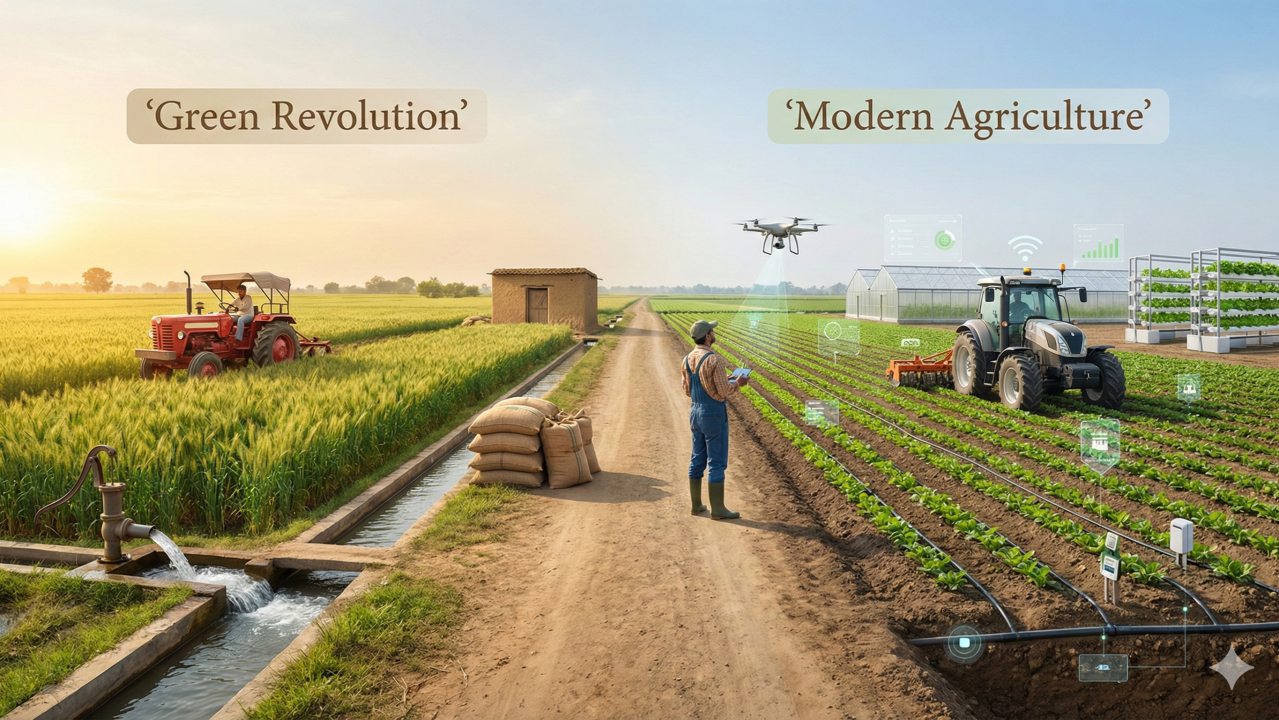
Indian agriculture is steadily moving toward a more technology-driven future. As farmers deal with rising input costs, labour shortages, water pressure, and the need for better productivity, the focus is shifting from traditional broad-based practices to more targeted and efficient methods. This is where precision farming is becoming increasingly important.
Precision farming uses technology, data, and field-specific insights to help farmers make better decisions across different stages of crop management. From monitoring crop health to improving spraying accuracy and input use, these tools are helping reshape how farming works in India. As adoption grows, precision farming technology is becoming a valuable part of modern agricultural progress.
The Shift from Traditional to Data-Led Farming
For a long time, farming decisions were often based on broad field-level assumptions, past experience, and uniform treatment across land. While that approach still shapes many farm practices, it can also lead to uneven input use, delayed interventions, and avoidable waste.
According to the Directorate of Economics and Statistics, India recorded 357.73 million tonnes of foodgrain production and 369.05 million tonnes of horticulture production in 2024–25, with cropping intensity at 155.85%. At that scale, even small gains in accuracy, timing, and input use can make a meaningful difference. Precision farming changes that by helping farmers respond to actual field conditions rather than treating every acre the same.
This shift matters because crop needs are rarely uniform across an entire field. Soil condition, moisture, crop health, pest pressure, and nutrient demand can vary from one section to another. Data-led farming helps farmers recognize these differences and make more targeted decisions on irrigation, fertilization, and crop protection. In practical terms, that means better control over resources and stronger day-to-day farm management.
Key Technologies Transforming Indian Agriculture
Precision farming is not built on a single tool. It is driven by a group of technologies that help farmers monitor fields more closely and act with greater accuracy.
1. GPS-based field mapping
Field mapping helps farmers understand variation within the land, including differences in soil, crop performance, irrigation patterns, and field boundaries. This makes planning more precise and supports better decisions across different parts of the farm.
2. Drones in agriculture
Drones are becoming one of the most visible precision farming tools in India. They are used for mapping, crop observation, and precision spraying, helping farmers assess conditions and carry out field operations faster and more accurately. Leher’s platform specifically focuses on making drone spraying in Indian agriculture more accessible through a service-based model.
3. Remote sensing and satellite imagery
Remote sensing gives farmers a broader view of crop health and field stress. By using aerial imagery or satellite-based observation, growers can spot uneven growth, moisture issues, or crop stress earlier than they might through manual inspection alone.
4. Soil and crop sensors
Sensors can help track moisture, nutrient status, and environmental conditions in real time. This improves decision-making by giving farmers better visibility into what the crop and soil actually need.
5. Variable rate application
Variable rate systems allow farmers to apply different amounts of inputs across the field depending on need. Instead of using one uniform application rate everywhere, this method supports more efficient and balanced input use.
6. Digital farm management tools
Digital platforms are also becoming part of modern agricultural practice. They help farmers track field data, organize crop plans, and connect observations with action more effectively over time.
Practical Impact on Crop Care and Efficiency
The real value of precision farming technologies lies in how they improve everyday farm operations. These tools do not just add sophistication; they help farmers work with more clarity, speed, and control.
1. Better crop monitoring
With stronger visibility into crop conditions, farmers can identify stress, pest activity, or uneven growth earlier. That makes field management more proactive and reduces the chance of small issues becoming larger losses.
2. More efficient spray operations
Precision farming also improves spray efficiency by making applications more timely and targeted. Technologies such as drone-based spraying can support better field coverage, less overlap, and more consistent execution during critical treatment windows.
3. Smarter input use
When water, fertilizer, and crop protection inputs are applied based on actual field need, farms can reduce waste and improve operational efficiency. This is especially important in an agricultural system where margins and resources often need to be managed carefully.
4. Faster decision-making
Because precision tools generate clearer field-level insights, they help farmers act faster. Whether the need is irrigation, nutrient correction, or crop protection, better timing can improve both crop care and efficiency.
Together, these improvements show how precision farming technologies can make crop care more responsive, resource-efficient, and better suited to the everyday demands of Indian agriculture.
The Growing Demand for Precision Farming in India
Precision farming is gaining attention in India because farmers are increasingly looking for solutions that improve efficiency without adding unnecessary complexity. Rising cultivation costs, labour-related challenges, and the need for better water and input management are making targeted farm practices more valuable than before.
- Rising input costs are pushing efficiency: Farmers are looking for ways to use water, fertilizers, and crop protection inputs more carefully to control costs and reduce waste.
- Labour challenges are increasing the need for smarter tools: Manual farm operations can be time-consuming and labour-dependent, which makes technology-led support more attractive.
- Farmers need better control over crop care: Precision farming helps improve timing, monitoring, and application accuracy, which supports more effective day-to-day farm management.
- Water and resource pressure is growing: Efficient use of water and other farm inputs is becoming increasingly important, especially in resource-sensitive agricultural systems.
- Service-based agri-tech is improving accessibility
Many precision solutions are becoming easier to access through platforms and providers, without requiring every farmer to invest in ownership. - Awareness around modern farming practices is increasing: As more farmers see the value of data-led and targeted agriculture, adoption is gradually becoming more widespread.
- Technology is becoming more relevant to real farm conditions: Precision tools are no longer seen as distant innovations. They are increasingly being viewed as practical solutions for everyday agricultural challenges.
These factors show why precision farming is moving from a niche concept to a more practical and widely relevant approach in Indian agriculture.
What This Means for the Future of Farming
The future of farming in India is likely to be more precise, more data-led, and more focused on efficiency than ever before. As agricultural challenges continue to grow, farmers will need solutions that help them make faster decisions, reduce waste, and respond more accurately to changing field conditions. Precision farming supports this shift by turning technology into a practical tool for everyday crop management rather than something limited to large-scale or experimental use.
In the coming years, farming is expected to rely more on real-time insights, targeted input application, and smarter planning across different stages of crop care. This can help improve productivity while also supporting more responsible use of water, labour, and crop protection resources. As access to these tools becomes easier, precision farming is likely to move from being an emerging concept to becoming a more regular part of modern agricultural practice in India.
What this could mean in practice:
- More accurate farm decisions: Farmers will be able to respond to field conditions with better timing and greater precision.
- Better resource efficiency: Water, fertilizers, and crop protection inputs are likely to be used more carefully and effectively.
- Stronger crop monitoring: Future farming will depend more on timely field insights instead of delayed manual observation.
- Wider use of technology in daily operations: Tools like drones, sensors, and digital farm platforms may become more integrated into routine farm management.
- A shift toward more sustainable agriculture: Precision farming can support productivity while reducing unnecessary waste and improving long-term farm efficiency.
These changes suggest that the future of farming will be shaped by smarter decisions, better technology use, and more efficient crop management across Indian agriculture.
Conclusion
Precision farming technologies are transforming Indian agriculture by making field decisions more accurate, crop care more efficient, and resource use more controlled. From mapping and sensing to drone spraying and digital planning, these tools are helping farmers move toward a smarter and more responsive way of farming.
As adoption grows, the role of precision farming technology will only become more important in shaping productive, efficient, and future-ready agriculture in India.